Understanding Late-Summer Pipe Failures in Tampa Slab Homes
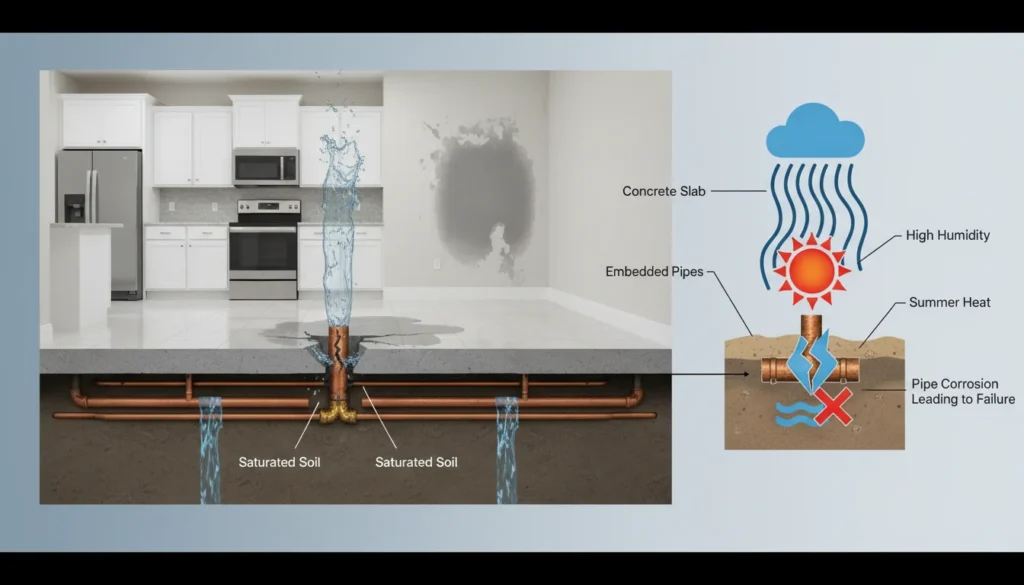
Tampa Bay homeowners with slab foundations often notice a troubling pattern: as summer winds down and September approaches, underground pipe failures spike dramatically. This isn’t coincidence—it’s the result of Florida’s unique climate conditions, soil composition, and construction practices converging in a perfect storm of plumbing stress. While Orlando and Tampa share similar environmental challenges, the specific combination of sandy soil, seasonal rainfall patterns, and extreme heat creates conditions that place tremendous strain on pipes embedded in concrete slabs during late summer months.
The phenomenon affects thousands of homes across the Tampa Bay region each year, resulting in costly repairs, water damage, and disrupted households. Understanding why this happens—and what you can do about it—can save homeowners significant money and stress.
The Science Behind Slab Foundation Construction in Florida
Slab-on-grade foundations dominate Florida residential construction for practical reasons. Unlike basement-dependent northern states, Florida’s high water table and limestone bedrock make slab construction the most economical and structurally sound option. These foundations consist of a single layer of concrete poured directly on prepared soil, with plumbing lines embedded within or beneath the slab itself.
This construction method creates an inherent vulnerability: pipes are encased in concrete with minimal room for expansion, contraction, or movement. When environmental stresses increase—as they do predictably each late summer—these rigid constraints amplify pressure on the plumbing system. The pipes cannot flex or shift naturally, forcing them to absorb stress that eventually manifests as cracks, pinhole leaks, or complete ruptures.
Why Pipes Are Embedded in Slabs
Building codes and construction economics drive the practice of running water lines through slab foundations. Supply lines must reach fixtures throughout the home, and routing them through the slab provides the most direct, protected pathway. Hot water lines, cold water supply lines, and sometimes drain lines all traverse the concrete, creating an extensive underground network that’s completely hidden from view until problems emerge.
This invisibility becomes a critical issue when leaks develop. Unlike exposed plumbing that shows obvious signs of failure, slab foundation leaks can go undetected for weeks or months, causing progressive damage to the foundation, flooring, and structure before homeowners realize there’s a problem.
Florida’s Unique Late-Summer Environmental Stressors
The late summer period—typically August through early October—subjects Tampa homes to a distinctive combination of environmental factors that stress slab foundations and their embedded plumbing systems.
Cumulative Heat Exposure
By late summer, concrete slabs and the soil beneath them have absorbed months of intense solar radiation and ambient heat. Surface temperatures on concrete can exceed 140°F, and this heat penetrates deep into the slab structure. The thermal expansion this causes affects both the concrete and the metal or plastic pipes within it, but at different rates. Copper pipes expand approximately 1 inch per 100 feet for every 100°F temperature increase, while concrete expands at a different rate, creating shearing forces at pipe-concrete interfaces.
The situation intensifies with hot water lines running through slabs, which experience both external heat from the surrounding concrete and internal heat from the water they carry. This dual thermal stress accelerates material fatigue and weakens pipe walls at vulnerable points.
Soil Moisture Fluctuations
Tampa’s late summer brings dramatic shifts in soil moisture content. The rainy season peaks in July and August, saturating the sandy soil beneath foundations. As September arrives and rainfall decreases, this moisture begins evaporating and draining away, causing soil consolidation and settlement. The soil literally shrinks as water content decreases, creating voids and removing support from portions of the slab.
This settlement isn’t uniform. Areas with better drainage dry faster, while low spots retain moisture longer, creating differential settlement across the foundation. The resulting stress concentrates at specific points in the plumbing system—typically at joints, bends, and transitions between pipe materials—where failures most commonly occur.
Pressure Changes from Seasonal Water Demand
Late summer coincides with peak water usage in Tampa Bay communities. Irrigation systems run extensively to combat heat stress on landscaping, swimming pools require frequent refilling due to evaporation, and household water consumption increases. This elevated demand creates pressure fluctuations throughout municipal water systems and within individual home plumbing networks.
Pipes already weakened by thermal stress and foundation movement experience repeated pressure cycling—surges when pumps activate, drops when multiple fixtures operate simultaneously. Each cycle propagates existing microcracks and stresses corroded sections until failure occurs.
Material-Specific Vulnerabilities in Tampa’s Climate
The type of piping material used in construction significantly influences failure risk, and Tampa homes built during different eras contain various materials with distinct vulnerabilities.
Copper Pipe Corrosion
Copper piping, common in homes built from the 1960s through 1990s, faces particular challenges in Florida’s environment. The combination of acidic soil conditions, chlorinated water, and electrical grounding systems that sometimes use plumbing as ground paths creates electrochemical corrosion. This process accelerates during late summer when heat increases chemical reaction rates and soil moisture changes expose pipes to varying pH levels.
Pinhole leaks—tiny perforations that develop from interior corrosion—become more common after 15-20 years of service, with failure rates spiking during late summer stress periods. These leaks often appear in clusters, as similar sections of pipe installed simultaneously reach failure thresholds together.
PEX and Plastic Pipe Issues
Newer homes often feature PEX (cross-linked polyethylene) or CPVC (chlorinated polyvinyl chloride) piping, marketed as corrosion-resistant alternatives to copper. However, these materials present their own late-summer vulnerabilities. PEX can degrade when exposed to chlorinated water at elevated temperatures—exactly the conditions present in late summer. CPVC becomes brittle over time, especially when subjected to thermal cycling, and can crack suddenly when stressed.
The fittings and connections used with plastic piping systems also represent failure points. Compression fittings can loosen as materials expand and contract, while glued joints may separate if the adhesive degrades under heat stress.
Geographic Variations Within the Tampa Bay Area
Not all Tampa neighborhoods experience identical risk levels. Soil composition, elevation, drainage patterns, and construction era create significant geographic variations in late-summer pipe failure susceptibility.
Coastal vs. Inland Properties
Homes in coastal areas face additional challenges from salt air and higher water tables. The salt accelerates corrosion of metal components and can degrade certain plastic materials. Properties in neighborhoods like Ybor City near Tampa’s historic waterfront may experience different failure patterns than inland developments.
Inland properties, conversely, often sit on sandier soil with better drainage but greater seasonal moisture variation. Areas such as Forest Hills and similar established neighborhoods may see more dramatic soil consolidation during late summer dry periods, increasing foundation stress and associated pipe failures.
Age of Development
Construction practices, materials, and code requirements have evolved significantly over Tampa’s development history. Homes built during rapid growth periods may have received less rigorous foundation preparation or used materials that haven’t aged well in Florida’s climate. Neighborhoods developed in the 1970s-1990s are now entering the prime failure window for original plumbing systems, with late summer providing the triggering stress for pipes already near end-of-life.
Warning Signs of Developing Slab Leaks
Recognizing early indicators of slab leaks can prevent minor issues from becoming major disasters. Tampa homeowners should watch for these warning signs, particularly during late summer months:
- Unexplained water bill increases: Even small slab leaks waste thousands of gallons monthly, creating noticeable billing spikes without corresponding usage changes
- Warm spots on floors: Hot water line leaks create detectable temperature differences on tile or concrete floors, especially noticeable in air-conditioned homes
- Sound of running water: When all fixtures are off, hearing water movement indicates active leaks somewhere in the system
- Foundation cracks: New or expanding cracks in slab edges, walls, or floor surfaces may indicate water undermining the foundation
- Mold or mildew odors: Persistent musty smells, particularly in specific areas, suggest hidden moisture from slab leaks
- Low water pressure: Unexplained pressure drops can indicate water escaping through underground leaks before reaching fixtures
- Wet or soft spots in flooring: Carpet that stays damp, buckling laminate, or loose tiles often sit above active leak sites
Detection Methods for Hidden Slab Leaks
Locating leaks embedded in concrete requires specialized equipment and expertise. Professional detection services employ several sophisticated techniques to pinpoint leak locations without destructive exploratory demolition.
Acoustic Leak Detection
The most common professional method uses sensitive audio equipment to detect the sound of water escaping pressurized pipes. Acoustic leak detection technology amplifies the distinctive frequency signature of water leaks, allowing technicians to trace pipes through concrete and identify leak locations within inches. This non-invasive approach saves homeowners the cost and disruption of unnecessary concrete removal.
Infrared Thermography
Thermal imaging cameras detect temperature variations in floors and walls caused by water leaks. Hot water line leaks create warm signatures, while cold water leaks may show as cool spots or moisture patterns. This technology works particularly well during late summer when temperature differentials are most pronounced.
Pressure Testing and Line Tracing
Isolating sections of plumbing and monitoring pressure loss helps identify which lines are leaking. Electronic line tracing equipment then maps the exact route of pipes through the slab, providing a roadmap for targeted repairs.
Prevention Strategies for Tampa Homeowners
While late-summer environmental stresses are unavoidable, homeowners can take proactive steps to minimize pipe failure risk and catch problems early.
Regular Plumbing Inspections
Annual professional inspections should include pressure testing, visual examination of accessible pipes, and review of water usage patterns. Scheduling these inspections in early summer, before peak stress periods, allows time to address developing issues before they become emergencies.
Water Pressure Management
Installing or adjusting pressure-reducing valves helps minimize stress on aging pipes. Municipal water pressure often exceeds what residential plumbing needs, and reducing pressure to 50-60 PSI extends pipe lifespan while maintaining adequate flow for household use.
Water Quality Treatment
Addressing corrosive water conditions through pH adjustment or filtration systems slows the electrochemical processes that degrade copper piping. Water softeners reduce mineral buildup that can accelerate corrosion in certain conditions.
Landscape and Drainage Optimization
Proper grading and drainage systems minimize soil moisture fluctuations around foundations. Directing downspouts away from the house, maintaining consistent irrigation schedules, and avoiding water accumulation near the foundation all contribute to more stable soil conditions that reduce stress on slabs and embedded pipes.
Monitoring and Documentation
Keeping records of water bills, noting any unusual patterns, and documenting even minor plumbing issues creates a history that helps professionals identify developing problems. Many homeowners photograph their water meters before and after periods when no water should be used (such as when away from home) to detect hidden leaks.
When to Call Professional Slab Leak Specialists
Slab leak detection and repair requires specialized knowledge, equipment, and experience. DIY approaches rarely succeed and often worsen problems by delaying proper intervention or causing additional damage during amateur detection attempts.
Homeowners should contact professional slab leak specialists immediately when they notice warning signs, particularly during late summer when minor leaks can rapidly escalate. Early professional intervention typically costs a fraction of what delayed repairs require once water damage affects flooring, cabinetry, or structural elements.
Professional services include accurate leak location, minimally invasive repair methods, foundation integrity assessment, and recommendations for preventing future failures. Experienced technicians understand Tampa’s specific environmental factors and can identify whether a single leak represents an isolated failure or indicates systemic issues requiring more comprehensive solutions.
The Cost of Delayed Action
Postponing slab leak repairs creates cascading problems that multiply costs exponentially. A small leak that initially requires only targeted pipe repair can evolve into a major project involving foundation remediation, mold abatement, flooring replacement, and structural repairs if left unaddressed.
Water damage from slab leaks often affects areas far from the leak site as moisture wicks through concrete and migrates along foundation edges. By the time visible damage appears, hidden deterioration may have progressed extensively. Insurance coverage for slab leaks varies significantly by policy, with many carriers distinguishing between sudden failures (often covered) and gradual damage from undetected leaks (frequently excluded), making early detection and documentation crucial.
Long-Term Solutions and Whole-House Repiping
For homes with aging plumbing systems, repeated slab leaks, or extensive corrosion, whole-house repiping may represent the most cost-effective long-term solution. This approach involves abandoning problem sections of slab plumbing and routing new supply lines through attics, walls, or other accessible spaces.
While repiping represents a significant upfront investment, it eliminates the recurring cycle of detection, repair, and water damage that characterizes homes with deteriorating slab plumbing. Modern materials and installation techniques create systems that will provide decades of reliable service without the vulnerabilities inherent in slab-embedded pipes.
The decision between targeted repairs and comprehensive repiping depends on factors including home age, plumbing material, number and location of previous failures, and long-term ownership plans. Professional slab leak specialists can assess your specific situation and provide guidance on the most appropriate approach.
Leave a Reply